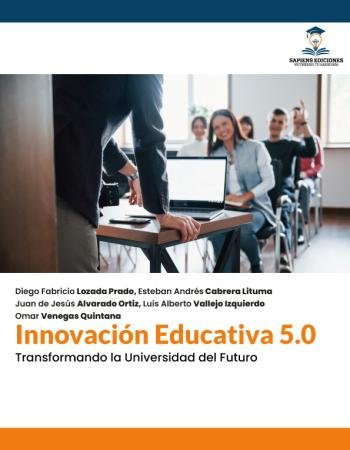
Innovación Educativa 5.0: Transformando La Universidad Del Futuro
Palabras clave:
Innovación Educativa 5.0, inteligencia artificial, educación superior, competencias digitales, transformación universitaria, tecnologías emergentesSinopsis
El libro Innovación Educativa 5.0: Transformando la Universidad del Futuro aborda de manera
integral los procesos de cambio que experimenta la educación superior en el contexto de la
transformación digital y la sociedad del conocimiento. A lo largo de sus capítulos, se analizan
los aportes de la inteligencia artificial, la analítica de datos, las metodologías activas, la
educación híbrida y las tecnologías emergentes como herramientas clave para la innovación
pedagógica y la mejora de la calidad educativa. La obra destaca la importancia de fortalecer
las competencias digitales del profesorado, rediseñar los modelos curriculares y promover
entornos de aprendizaje flexibles, inclusivos y centrados en el estudiante. Asimismo, se
reflexiona sobre los desafíos éticos, sociales y formativos que plantea la Educación 5.0,
posicionando a la universidad como un espacio estratégico para la formación de profesionales
críticos, creativos y comprometidos con el desarrollo sostenible y la transformación social.
Referencias
Alalwan, N. (2022). Technology acceptance and use in higher education: A systematic review and meta-analysis. Education and Information Technologies, 27, 10893–10915. https://doi.org/10.1007/s10639-022-11071-z
Bond, M., Bedenlier, S., Buntins, K., Zawacki-Richter, O., & Kerres, M. (2020). Mapping research in student engagement and educational technology in higher education: A systematic evidence map. International Journal of Educational Technology in Higher Education, 17(1), Article 2. https://doi.org/10.1186/s41239-019-0176-8
CAST. (2018). Universal design for learning guidelines version 2.2. http://udlguidelines.cast.org
Comisión Económica para América Latina y el Caribe (CEPAL). (2022). Transformación digital y educación superior en América Latina. Naciones Unidas.
Daniel, B. K. (2015). Big data and analytics in higher education: Opportunities and challenges. British Journal of Educational Technology, 46(5), 904–920. https://doi.org/10.1111/bjet.12230
Delors, J. (1996). Learning: The treasure within. UNESCO.
European Commission. (2020). Lifelong learning policies and strategies. Publications Office of the European Union.
Freire, P. (2005). Pedagogy of the oppressed (30th anniversary ed.). Continuum.
García-Peñalvo, F. J. (2021). Digital transformation in higher education: The hybrid learning model. Education in the Knowledge Society, 22, e25065. https://doi.org/10.14201/eks.25065
Gardner, H. (2011). Truth, beauty, and goodness reframed: Educating for the virtues in the twenty-first century. Basic Books.
Jackson, D. (2016). Re-conceptualising graduate employability: The importance of pre-professional identity. Higher Education Research & Development, 35(5), 925–939. https://doi.org/10.1080/07294360.2016.1139551
Keyes, C. L. M. (2007). Promoting and protecting mental health as flourishing. American Psychologist, 62(2), 95–108. https://doi.org/10.1037/0003-066X.62.2.95
Knowles, M. S. (1984). The adult learner: A neglected species (3rd ed.). Gulf Publishing.
Mayer, R. E. (2021). Multimedia learning (3rd ed.). Cambridge University Press.
Mishra, P., & Koehler, M. J. (2006). Technological pedagogical content knowledge: A framework for teacher knowledge. Teachers College Record, 108(6), 1017–1054.
Moreno, R., & Mayer, R. E. (2019). Interactive multimodal learning environments. Educational Psychology Review, 31, 847–873. https://doi.org/10.1007/s10648-019-09454-2
Nicol, D. (2024). Challenges for maintaining quality assessment in higher education. Accountancy and Business Review, 16(2), 45–59.
Nussbaum, M. C. (2010). Not for profit: Why democracy needs the humanities. Princeton University Press.
Organisation for Economic Co-operation and Development (OECD). (2019). Artificial intelligence in society. OECD Publishing. https://doi.org/10.1787/eedfee77-en
Organisation for Economic Co-operation and Development (OECD). (2021). OECD digital education outlook 2021: Pushing the frontiers with artificial intelligence, blockchain and robots. OECD Publishing.
Organisation for Economic Co-operation and Development (OECD). (2021). OECD skills outlook 2021: Learning for life. OECD Publishing.
Puentedura, R. R. (2014). SAMR: Transformation, technology, and education. Hippasus. http://www.hippasus.com
Römgens, I., Scoupe, R., & Beausaert, S. (2020). Unraveling the concept of employability, bringing together research on employability in higher education and the workplace. Studies in Higher Education, 45(12), 2588–2603. https://doi.org/10.1080/03075079.2019.1623770
Rose, D. H., & Meyer, A. (2002). Teaching every student in the digital age: Universal design for learning. ASCD.
Sen, A. (1999). Development as freedom. Oxford University Press.
Siemens, G. (2013). Learning analytics: The emergence of a discipline. American Behavioral Scientist, 57(10), 1380–1400. https://doi.org/10.1177/0002764213498851
UNESCO. (2019). Education for sustainable development framework beyond 2019. UNESCO.
UNESCO. (2021). AI and education: Guidance for policy-makers. UNESCO.
United Nations. (2018). The sustainable development goals report 2018. United Nations.
Wakefield, A., Pike, R., & Amici-Dargan, S. (2023). Learner-generated podcasts as authentic assessment. Assessment & Evaluation in Higher Education, 48(7), 1025–1037. https://doi.org/10.1080/02602938.2022.2102304
Wiggins, G. (2011). A true test: Toward more authentic and equitable assessment. Phi Delta Kappan, 92(7), 81–93.
Williamson, B., & Eynon, R. (2020). Historical threads, missing links and future directions in AI in education. Learning, Media and Technology, 45(3), 223–235. https://doi.org/10.1080/17439884.2020.1798995
World Economic Forum. (2023). The future of jobs report 2023. World Economic Forum.
World Health Organization. (2022). Mental health at work. World Health Organization.
Zawacki-Richter, O., Marín, V. I., Bond, M., & Gouverneur, F. (2019). Systematic review of research on artificial intelligence applications in higher education—Where are the educators? International Journal of Educational Technology in Higher Education, 16(1), Article 39. https://doi.org/10.1186/s41239-019-0171-0
Publicado
diciembre 11, 2025
Derechos de autor 2025 Sapiens Editions


